
Tilia makes Collaborative Care worth operating.
Your patients already qualify.

Tilia supports your patients every day — monitoring, care-manager follow-up, focused psychiatric review, remission tracking, and the documentation behind Collaborative Care. Reduce the manual burden, support more patients, and turn behavioral health work you already carry into structured, reimbursable care.
The gap

Three options. Each one quietly costs your practice.

When a primary care patient needs mental health care, you have three options — refer out, manage it yourself, or watch them come back. The work lands on your practice either way. The reimbursement usually doesn't.

You refer out

Psychiatry waits run months and most patients never complete the referral. You've spent the visit and captured no behavioral health revenue.

You prescribe and manage it

You absorb the follow-ups, portal messages, and monitoring between visits — unpaid, outside your specialty, and on your liability.

The patient comes back

Still symptomatic, still yours — now burning more visit slots while the underlying condition stays unbilled and unmanaged.

What Tilia is

A continuous psychiatric care service, behind your practice.

A daily, continuous psychiatric collaborative care service that brings care-management support, psychiatric review, patient monitoring, remission follow-up, and documentation workflows behind the scenes.

Alongside, not instead

Your patients stay yours. Tilia supports the work around them, so primary care does not have to become psychiatry.

Built to make Collaborative Care practical

Turn behavioral health follow-up you already provide into structured, documented, reimbursable activity — without building the operating layer yourself.

Fits your process

Start with the workflow your practice already uses. We handle enrollment, monitoring, follow-up structure, and review preparation.

Documentation built in

Activity logs, review records, care-plan updates, remission status, and escalation notes — organized to support Collaborative Care billing workflows.

What you get

Concise outputs, routed to the right person.

Care-manager worklists

Who needs outreach, symptom follow-up, adherence clarification, side-effect review, or psychiatric case review.

Psychiatric review briefs

Concise case summaries that prepare the supervising psychiatrist for focused, efficient review.

PCP summaries

Clear updates on stability, clinical issues, medication concerns, escalation status, and next decision points.

What makes us different

A clinical operating layer
not just CoCM admin.

Tilia turns patient signals into care-manager action, psychiatric review preparation, remission monitoring, and clinician-reviewed escalation.

Typical CoCM enablement Tilia
Tracks enrolled patients and monthly scores Builds an ongoing patient-state picture from symptoms, function, adherence, side effects, engagement, and response patterns.
Supports billing documentation Supports documentation plus the care-manager actions and psychiatric review workflows behind it.
Uses fixed check-ins and periodic measurement Provides continuous engagement and monitoring, adjusted to patient need and clinical boundaries.
Flags obvious risk Surfaces early drift, disengagement, adherence problems, and side-effect signals before the next scheduled visit.
Focuses on active treatment Extends into a low-touch remission year, monitoring stability and relapse signals after acute improvement.
Grounded in evidence

An approach the evidence already backs.

Tilia delivers the Collaborative Care Model (CoCM) — a team-based approach where a behavioral care manager and a supervising psychiatrist work with you to treat depression and anxiety to measurable targets. It's the most rigorously studied model in integrated behavioral health, and Medicare reimburses it through dedicated CPT codes.

90+
randomized controlled trials behind the Collaborative Care Model.
2017
recognized and Medicare-reimbursed since.
100%
psychiatrist-supervised — human oversight on every case.

Team-based care

You, a behavioral care manager, and a consulting psychiatrist share one plan for each patient.

Measurement-based

Validated tools like PHQ-9 and GAD-7 track every patient and guide treatment to target.

Population-based

A registry reviews the whole caseload — not just who shows up — so no patient is forgotten.

Stepped & proactive

Care intensifies when a patient isn't improving — before things escalate into a crisis.

Founding practices

Set up personally, around how you work.

We're partnering with a small number of founding practices, each set up hands-on by our team and shaped around your workflow. Here's what the first month looks like.

1
A 20-minute walkthrough. No obligation — we show you how it fits your practice.
2
Tailored setup. We configure the model around your existing referral process — hands-on.
3
Go live with your first patients. The care team engages within days, not months.
4
We handle the rest. Supervision, documentation, charges, and the audit trail.
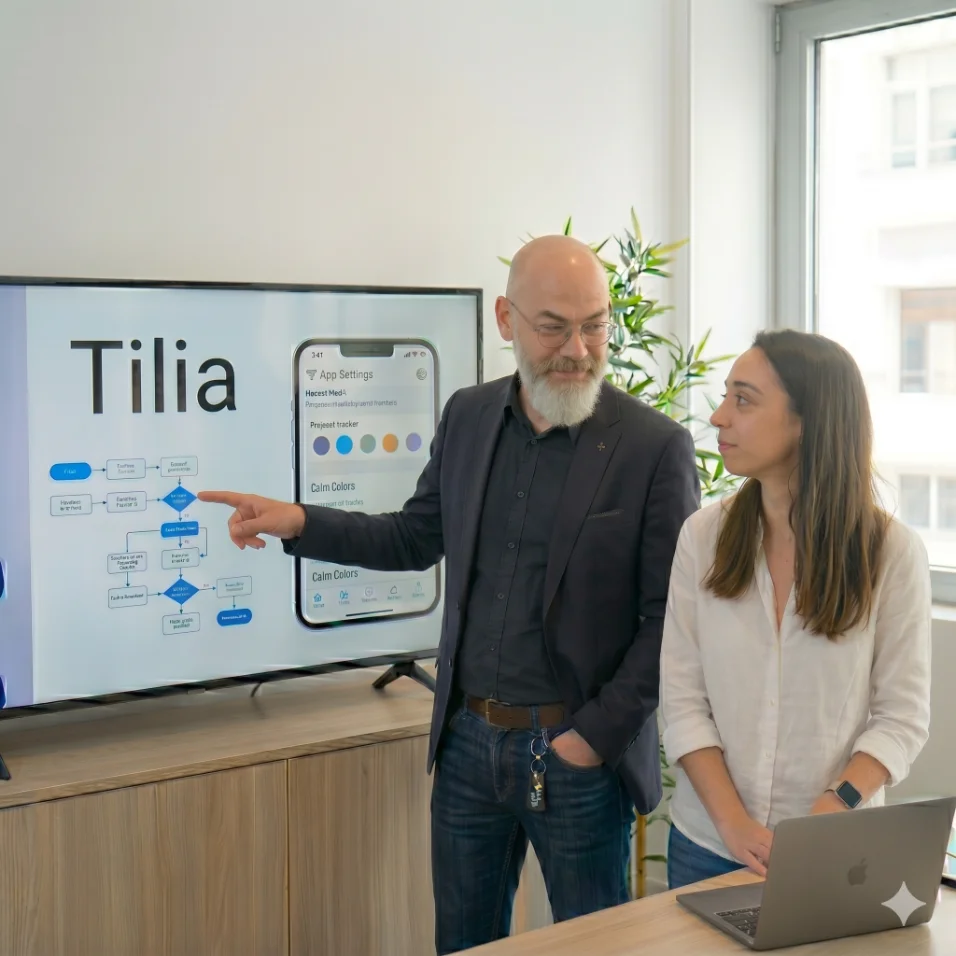
A Tilia team member walking a partner physician through the platform.

A few things you might be wondering.

Tilia was founded in Israel, where the mental health system faced an unprecedented demand crisis following October 7, 2023. What followed was rapid, forced learning — scaling psychiatric support across a population in acute distress, building triage and monitoring systems under real pressure, and understanding at close range what breaks down when demand overwhelms capacity. That experience shaped the clinical model, the escalation logic, and the core belief that collaborative care must be operationally feasible — not just theoretically sound. The U.S. service is being designed for U.S. primary care realities: licensed clinical coverage, HIPAA-ready operations, data governance, malpractice coverage, and workflow fit for American practice. We are validating the model with U.S. physicians before we scale — not after.
No. Tilia is AI-powered, but AI supports the workflow — it does not replace clinician judgment. AI handles monitoring, signal detection, worklist generation, psychiatric review preparation, and documentation. It does not diagnose, prescribe, or make independent clinical decisions. Every high-stakes decision is reviewed by a licensed clinician. The technology exists to make collaborative care scalable — not to remove clinicians from care.
Liability must be clearly allocated in the service agreement and clinical workflow. The practice remains the treating provider. Tilia provides defined support services. Licensed clinicians involved in care or psychiatric review operate within their professional responsibilities. Escalation pathways, documentation, response times, and emergency boundaries are explicit — not a gray zone.
That is exactly the problem Tilia is designed to address. Many practices know CoCM exists but do not operate it because the burden feels larger than the revenue: patient outreach, registry tracking, care-manager work, psychiatric review, time documentation, consent, billing risk, and audit concerns. CoCM becomes attractive only when the operating burden drops. Tilia handles the daily support layer, organizes care-manager follow-up, prepares psychiatric review, and produces documentation that supports CoCM workflows.
It fails if it adds work, creates alert fatigue, produces documentation nobody trusts, does not engage patients, creates billing uncertainty, or makes the PCP feel more exposed. That is exactly why we are validating the operating model with founding practices before scaling — not after.
The Collaborative Care Model has a strong evidence base and is recognized in Medicare reimbursement policy. Tilia is built around that established model. The evidence base belongs to CoCM as a model. Tilia’s own U.S. evidence will be generated through real-world deployment and outcomes tracking. We are not asking you to believe Tilia has already proven U.S. outcomes at scale — we are saying the underlying model is established, and Tilia is designed to make it easier to operate.
The codes most physicians recognize are 99492 (initial psychiatric CoCM month), 99493 (subsequent month), 99494 (additional time), G2214 (shorter initial service), and 99484 (General BHI, which is not full CoCM). CMS describes these as monthly services requiring structured care activity and documentation. Practices should confirm coding, payer rules, and current requirements with their billing and compliance advisors.
Tilia is not a crisis service. If a patient shows signs of acute risk, the case is escalated according to defined clinical protocols and emergency pathways. Our role is to identify concerning signals early, route them to appropriate clinical review, and document the escalation process. Acute safety situations require immediate clinical or emergency response — not routine CoCM management.
Daily support must be clinically bounded. Patient expectations, response windows, escalation rules, and crisis disclaimers must be clear. The point is not to create unlimited dependency or promise emergency availability — it is to maintain structured engagement, monitor relevant changes, and escalate appropriately when concerning patterns appear. These boundaries are defined explicitly before any patient contact begins.
No. At this stage we only ask for a conversation. We do not need referrals, patient data, or long-term commitment. We need your candid input on whether this solves a real problem in your practice — and what would make you trust it, pay for it, or reject it immediately.

See if Tilia can improve your Collaborative Care economics.

A 20-minute walkthrough focused on your current behavioral health burden, staff cost, reimbursement friction, and how many patients Collaborative Care could realistically support.